
This symposium took place on 25 and 26 June at the University of Aveiro, Portugal, and featured multiple activities related to the work of the ILLIANCE Agenda.
The work of the University of Aveiro and Petibol was presented by Miguel Paiva Dias from the University of Aveiro through the oral communication “Feasibility of recycling expanded polystyrene through CBA-assisted extrusion and underwater pelletisation” by authors Miguel Paiva Dias, Carlos Correia, Raquel Araújo, Victor Neto and Tatiana Zhiltsova. The widespread use of expanded polystyrene (EPS) in packaging and insulation generates enormous amounts of waste, causing environmental problems due to its low biodegradability and inefficient recycling. Due to structural degradation and the loss of blowing agents, only about 20% of recycled EPS can be converted into new products. The development of efficient recycling mechanisms is essential to reduce plastic waste and promote a circular economy. The objective of the study presented is twofold. The first objective is to establish the feasibility of EPS recycling. The second objective is to adapt a twin-screw extruder for the production of EPS granules through the design and manufacture of a prototype underwater pelletiser. This approach allows the integration of environmentally friendly chemical blowing agents (CBAs) by extrusion, while the moulding of 100% recycled EPS granules is carried out by the custom-designed underwater pelletising system. To determine the thermal degradation of recycled EPS prior to reprocessing, thermal analyses were performed using differential scanning calorimetry (DSC) and thermogravimetric analysis (TGA). The results indicated that there was no significant difference in glass transition temperatures, which were 103.7 ± 0.3 °C for the recycled material and 102.4 ± 0.3 °C for the expandable PS beads. The TGA results showed that expandable PS has an onset of mass loss at 94 °C and a peak temperature at 110 °C, absent in recycled EPS, suggesting the presence of residual volatile components that evaporate at this temperature. Expandable PS is less thermally stable and begins to degrade at 316 °C, while recycled EPS showed degradation starting at 346 °C, both with degradation peaks at around 418 °C. These findings confirm that reprocessing does not compromise the thermal stability of recycled EPS, indicating that there are no obstacles to its reuse through CBA-assisted extrusion. The adaptation of the extrusion process is currently in the adjustment phase. Future work will focus on optimising the extrusion parameters to produce CBA-expanded PS granules with the desired quality. This action was part of WP1 – Proj. 5 ‘100% recycled EPS’.
Representing the University of Aveiro and Maxiplás, Plásticos de Engenharia, Lda, were Emad Izadi Vasafi, Victor Neto and Tatiana Zhiltsova from UA and Luis Rodrigues and Lopes da Silva from MAXIPLÁS, Plásticos de Engenharia, Lda. participated with the oral presentation ‘Improving the performance of electronics manufacturing in moulds through numerical simulation’ by authors Emad Izadi Vasafi, Luis Rodrigues, Lopes da Silva, Victor Neto and Tatiana Zhiltsova. This research, presented at the IPA25 conference, is a central component of the ILLIANCE Agenda Project (C644919832-00000035). The numerical simulation of the In-Mould Electronics (IME) process directly supports the project's objectives, assisting in the design of the mould for an optimal injection channel configuration (aiming for the lowest clamping force and injection pressure), providing guidelines for the choice of injection moulding machine and ensuring balanced mould filling without visible defects such as weld lines. This work is crucial for the advancement of innovative manufacturing within the project. This action was framed in WP4 – Porj. 27 “Sensing Home”.
From the University of Aveiro and OLI Inês Santos from the University of Aveiro gave an oral presentation entitled ‘Rheological behaviour, thermal, mechanical and morphological properties of the hemp fibres-reinforced PP composite.’ Authors: Inês Santos, Tatiana Zhiltsova, José Martinho Marques de Oliveira, Sara P. Magalhães da Silva, Andreia Costa and Mónica S.A. Oliveira. The work addressed the rheological, thermal, mechanical and morphological characterisation of polypropylene composites reinforced with hemp fibres, with the aim of exploring sustainable solutions for industrial applications, namely in the production of a sanitary control panel. Participation allowed for the dissemination of research results and the updating of knowledge in the field of polymeric materials. This action was part of WP4 – Proj. 22 “OLI Push”.
Also from the University of Aveiro and OLI, Afonso Pereira, also from UA, gave an oral presentation entitled ‘Evaluating the recyclability of polymers in sanitary ware applications’ by authors Afonso Pereira, Tatiana Zhiltsova, Andreia Costa and Mónica S. A. Oliveira. The presentation focused on the methodology defined for assessing degradation in end-of-life OLI polymeric material and the respective results. Through rheological, thermal and mechanical analyses, the post-consumer material was characterised in order to analyse its potential for recovery, with a view to reintroducing the recycled material to produce a high-performance product without loss of quality, promoting product circularity. This action was also part of WP4 – Proj. 22 ‘OLI Push’.
Other News
A Universidade de Aveiro esteve presente na conferência Internacional “On energy from space 2025” qu
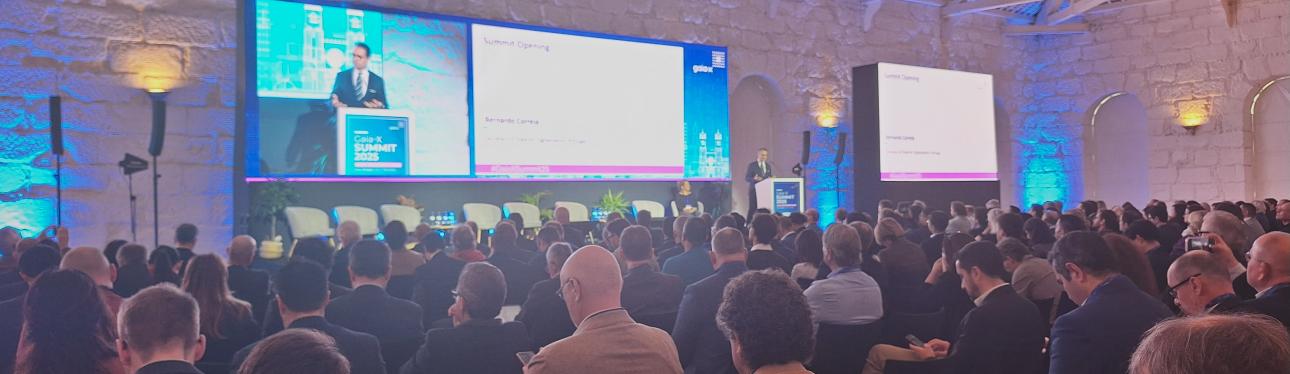
The Porto Customs Building (Edifício da Alfândega do Porto) hosted the Gaia-X Summit 2025 on November 20 and 21, unde
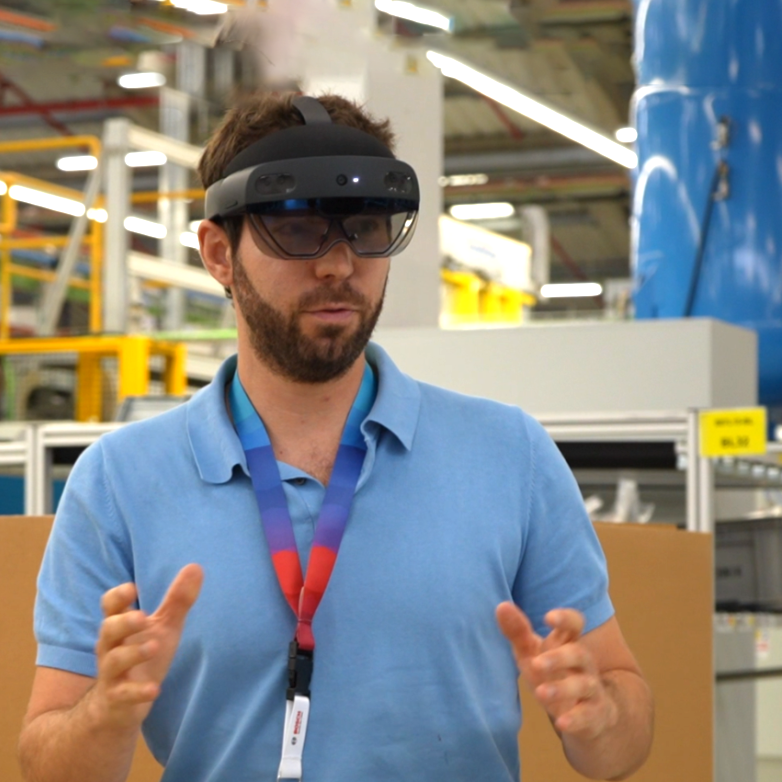
A team from Bosch Termotecnologia has been distinguished with the international Bosch award – the Bosch Digit